
Pool Automation in Milpitas, CA
Pump, heater, lights and spa tied to one controller and one app, set up and programmed right.

Schedule Service!
Pool Automation Installation, Upgrades and Repair
Most pools start with a mechanical timer on the pump and a row of switches for everything else. Our pool automation in Milpitas replaces that with one controller that runs the pump, heater, lights, spa and more on a schedule, from a panel or an app on your phone.
What Our Automation Service Covers
- Automation system installation
- Upgrades from old timers and switches
- Schedule and speed programming
- Mobile app and Wi-Fi setup
- Automation troubleshooting and repair
Systems We Work On
We install and service automation from Hayward, Pentair, Jandy and Zodiac. If you already have a controller, we can usually repair or expand it instead of starting over.
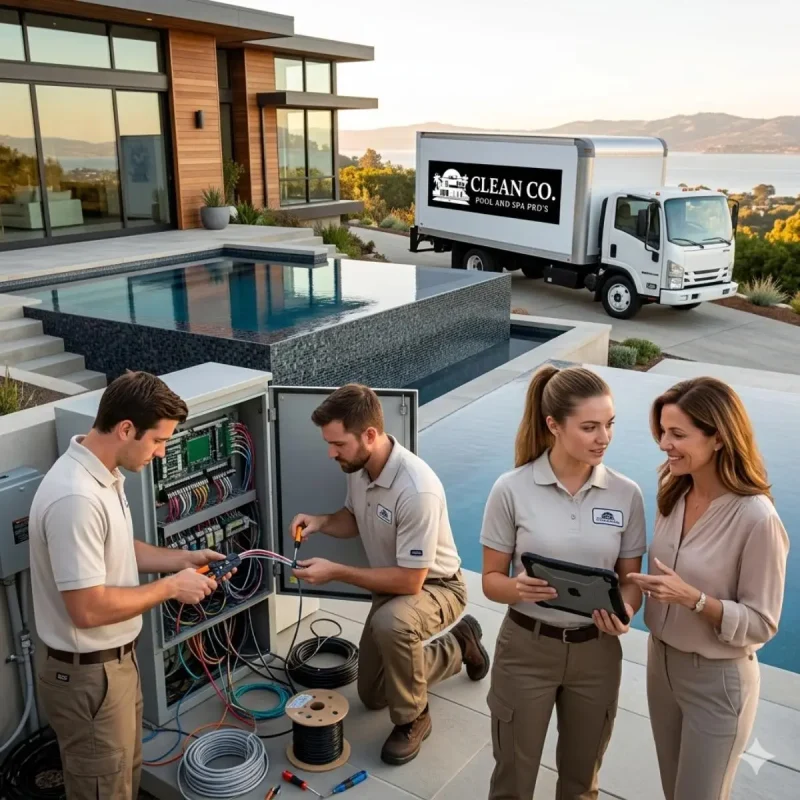
Tired of Timers and Switches? Get a Free Pool Automation Quote
We Are Experts With:




What a Pool Automation System Does
A pool automation system is a controller wired to the equipment on your pad. Instead of turning each piece on and off by hand, you set schedules once, and then the controller handles the rest. When you want something now, like the spa hot by eight, you tap it on your phone.
The controller also makes the equipment work together. It can speed the pump up when the heater fires, turn the cleaner on only after the filter has had a head start, and switch the valves for spa mode in one step. That coordination is where most of the convenience and a good share of the savings come from.
What Pool Automation Can Control
- Variable speed pump schedules and speeds
- Gas heaters and heat pumps
- Pool and spa lights, including color shows
- Valve actuators that switch between pool and spa
- Booster pumps for pressure-side cleaners
- Salt chlorine generators
- Waterfalls, fountains and other water features
Even so, most systems have a set number of relays and valve outputs. Planning for equipment you might add later, like a heater or new lights, keeps you from outgrowing the controller.
Pentair, Hayward and Jandy Automation Systems
The three big names each make a full line of controllers. Pentair’s is IntelliCenter, with the older EasyTouch still running on a lot of pools. Hayward’s is OmniLogic, with the smaller OmniPL. Jandy’s is iAquaLink.
Each one works best with its own brand’s pumps, heaters and lights, because that equipment can talk to the controller directly. They can also run other brands through relays, though with fewer features. The right choice usually depends on what’s already on your pad.
Pool and Spa Automation
An attached spa is where automation shines. Switching to spa mode normally means turning valves, changing pump speed and starting the heater. With valve actuators and a controller, one button does all of it.
You can start heating the spa from your phone on the way home, so it’s ready when you walk in. When you’re done, the system switches back to the pool, turns off the heater and drops the pump to its normal speed. For choosing a heater to pair with it, see pool heater installation.
Automation and Variable Speed Pumps
A variable speed pump saves the most when something tells it what speed to run. On its own, it follows a basic schedule. Tied to automation, it can drop to a low speed for everyday filtering, ramp up for the heater or cleaner, and go back down the moment those finish.
So if your pump is due for replacement, plan it together with automation to save wiring work. For sizing a new one, see pool pump installation.
Pool Automation App and Remote Control
Every current system has an app for your phone that works over your home Wi-Fi. From it you can check water temperature, change schedules, run the lights and turn the spa on from anywhere.
That said, a good Wi-Fi signal at the equipment pad matters more than people expect. Many connection problems come down to a weak signal at the side of the house. Some systems also offer a wall-mounted remote inside the house for anyone who’d rather not use an app.
Automated Chemistry: pH and Chlorine Probes
Some systems add chemical sensing. Probes in the plumbing read pH and chlorine levels, and the controller turns feeders or the salt cell up or down to match. It catches swings faster than a weekly test can.
Probes still need looking after, though. A thin film builds up on them over time and makes the readings drift. High stabilizer also pulls down the reading chlorine probes give. So even with automated chemistry, the water still needs regular hand testing, and the probes need cleaning and calibration.
Salt Chlorination Through the Controller
Many controllers can run a salt cell directly. On those systems, the salt output, cell cleaning cycle and salt level warnings all show up in the same app as the pump and heater.
That makes a salt conversion a natural add-on to an automation upgrade. Our pool salt systems page explains how salt chlorination works.
Pool Lights and Water Features
Lights are one of the most used parts of any automation system. Once they’re on the controller, you can set them to turn on at sunset and off at bedtime, or pick a color show from your phone.
Water features work the same way. A waterfall or bubbler can run on its own schedule, or only when you’re entertaining, instead of all day. If you have several color lights, choosing ones from the same brand as the controller lets them sync. For new fixtures, see pool light installation.
Freeze Protection
Milpitas doesn’t freeze often, but a few winter nights each year can get close. Most automation systems have freeze protection that turns the pump on when the air drops toward freezing. Moving water is much less likely to freeze and crack pipes or equipment.
Also, you can usually set the temperature that triggers it and choose which equipment runs. It’s worth checking that it’s turned on before the first cold snap.
Adding Automation to an Existing Pool
You don’t need a new pool to get automation. Most systems are built to replace an old timer and switches on existing equipment. The controller mounts near the pad, and the pump, heater and lights get wired to it.
After that, valve actuators can go on the existing valves for pool and spa switching. Older equipment that can’t talk to the controller still works through a relay, just with simple on and off control. We’ll look at what you have and tell you what can connect.
Why Automation Isn’t a DIY Install
An automation controller is a high-voltage panel that powers most of the equipment in your backyard. Hayward’s automation FAQ says its controllers must be installed under the National Electrical Code and local codes, not by homeowners.
Beyond the wiring, the equipment also has to be bonded and grounded, and each relay has to match the load it carries. A mistake can damage equipment or create a shock hazard around water.
Pool Automation Repair
When an automation system acts up, the problem usually shows up as equipment that won’t come on, a schedule that stopped running or an app that won’t connect. The most common causes:
- Lost Wi-Fi connection or a router change
- A failed relay that no longer switches a pump or light
- A valve actuator that won’t turn
- A bad temperature or flow sensor
- A communication error between the controller and a variable speed pump
- Damage from a power surge
Once we find the cause, many of these turn out to be small repairs. For problems with the pump, heater or filter themselves, see pool repairs.
Pool Automation Cost
Pricing comes down to how many pieces of equipment the system controls and how many valve actuators and relays that takes. The distance from the house to the pad matters too, and so do extras like chemical sensing or salt control.
A basic controller for a pump, heater and lights costs far less than a full pool and spa system with color lights and water features. The free quote lists the system and every add-on, so you can decide what’s worth it.
Getting the Most From Pool Automation
- Keep everyday filtering at a low pump speed, and only go higher when a job calls for it.
- Schedule the heater and cleaner to run with a higher pump speed, not all day.
- Set the lights on a timer so they’re only on in the evening.
- Keep the controller’s software updated when updates come out.
- Check freeze protection each fall.
Booking Pool Automation in Milpitas
Want an automation quote or a repair visit? The number is (408) 317-7550, and the quote form works too. A photo of your equipment pad helps us see what’s there. We install and repair automation in Milpitas and the cities on our service map. Our specialty pool services page lists the rest of our one-time work.
Pool Automation Questions
What people ask before adding or fixing a pool automation system. More questions? Call (408) 317-7550.
It depends on how much equipment the system controls, how many valve actuators and relays it needs, and the wiring. We give free quotes.
A controller that runs the pump, heater, lights, spa valves and other equipment on schedules, with control from a panel or a phone app.
Usually, yes. Most systems replace an old timer and switches on the equipment you already have. Older gear connects through relays.
It depends on your equipment. Pentair, Hayward and Jandy systems each work best with their own brand's pumps, heaters and lights.
Usually a weak Wi-Fi signal at the equipment pad or a changed router password. Resetting the controller's network settings often fixes it.
Yes. Current automation systems have apps that let you run the pump, heater, lights and spa from anywhere with a connection.
It can, mostly by running a variable speed pump at low speed and only using the heater when you want it. Savings depend on your equipment.
Many controllers can run a salt cell directly, with salt level and cell status shown in the same app.
A setting that turns the pump on when the air gets close to freezing, so moving water protects the pipes and equipment.
It's not a DIY job. The controller is a high-voltage panel that has to be wired, bonded and grounded to code.