
Pool Heater Repair in Milpitas, CA
Gas heaters, heat pumps and spa heaters brought back to steady, reliable heat.

Schedule Service!
Pool Heater Service for Gas Heaters, Heat Pumps and Spas
A cold pool in May usually traces back to one of three things: water flow, fuel or power, or a part inside the heater. Our pool heater repair in Milpitas works through all three, finds the one that stopped the heat and fixes it, on gas heaters, electric heat pumps and spa heaters alike.
What Our Heater Repair Covers
- Gas pool heater repair
- Electric heater and heat pump repair
- Spa heater repair
- Thermostat and control problems
- Ignition problems
Catching Heater Trouble Early
Regular pool heater service catches most problems early. On our weekly pool service, the heater gets looked at on every visit along with the pump and filter. When something starts to go wrong, it shows up in your visit report before it leaves you with a cold pool.
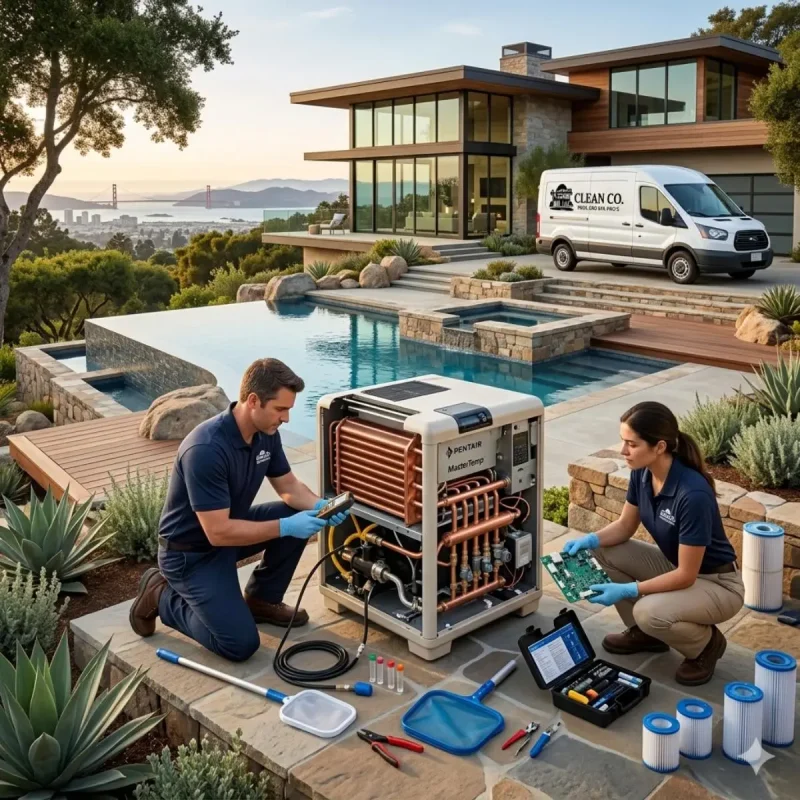
Heater Won't Fire or Won't Hold Heat? Get a Free Repair Quote
We Are Experts With:




Why a Pool Heater Stops Heating
When a pool heater is not heating, the heater itself isn’t always the problem. Every heater depends on three things outside the cabinet: enough water moving through it, a steady supply of gas or electricity, and controls that tell it to run. Lose any one of them and the heater sits idle.
That’s why swimming pool heater repair starts with the easy checks. Make sure the pump is running, the filter is clean, the gas valve is open, the breaker is on and the heater is set to heat rather than off or spa mode. A surprising number of service calls end right there.
If all of that checks out, the problem is inside the heater. The sections below cover the most common failures.
Gas Pool Heater Problems
Most gas pool heater repair comes down to ignition. Older heaters use a standing pilot and a thermocouple that turns the pilot’s heat into a small current to open the gas valve. Newer ones use electronic ignition, which sparks to light the pilot or burner each time the heater calls for heat. A weak thermocouple, a worn igniter or a failing flame sensor can all leave the burners dark.
Soot is another warning sign. Black residue on the burners or heat exchanger comes from a poor mix of fuel and air, often caused by a blocked air intake, debris in the burner tray or insects nesting inside. Hayward’s heater guide lists soot from an improper fuel and air mixture as one cause of heat exchanger failure, so a sooty heater should be shut down until it’s fixed.
Propane heaters need extra care. Propane is heavier than air, so unburned gas settles at the bottom of the heater instead of drifting away. Never keep trying to relight a propane heater that won’t catch.
Pool Heat Pump Repair
A heat pump doesn’t burn anything. It pulls heat out of the air and moves it into the water, using a refrigerant loop, a compressor and a fan. For every unit of electricity it uses, a heat pump can deliver three to eight units of heat, which is why it costs far less to run than a plain electric heater.
That also means it depends on the air around it. As the air cools, a heat pump puts out less heat, so a slow warm-up on a cold morning isn’t always a fault. A thin layer of frost on the coil during cool, damp weather is normal too, and the unit melts it off on its own. A thick block of ice, a fan that won’t spin or a compressor that hums but never starts are real problems.
Low water flow shuts a heat pump down just like a gas heater, and a coil caked with dirt and leaves can’t pull heat from the air.
Spa Heater Problems
Spa heaters work harder than pool heaters. They raise a small body of water many degrees in a short time, and they cycle on and off far more often. The heater and its controls wear out sooner as a result.
Hot water also drops calcium faster than cool water, so scale builds inside spa heaters quickly when the water balance slips. Electric immersion heaters, common on standalone spas, are slow to recover and expensive to run. Many spa owners with a shared pool and spa system heat the spa with the main pool heater instead.
Water Flow and the Pressure Switch
Every pool heater has a pressure or flow switch that stops it from firing when too little water is moving through it. Without enough flow, the heat exchanger would overheat. So when flow drops, the heater simply won’t start, even though nothing inside it is broken.
A dirty filter is the most common cause. Clogged pump and skimmer baskets, a partly closed valve, a low water level or a bypass valve set the wrong way do the same thing. Clean the filter, and the heater often fires right up. Our pool filter cleaning page covers how often that should happen.
If flow is good and the heater still shows a pressure or flow error, the switch itself may have failed, or the tubing that feeds it may be clogged.
Scale and Corrosion Inside the Heater
Water chemistry does more damage to heaters than age does. When calcium hardness, pH or alkalinity run high, scale forms fastest at the hottest spot in the system, which is the heat exchanger. Scale acts like insulation. The heater burns more fuel for less heat, runs hotter than it should and can trip its high-limit switch.
Low pH does the opposite. Corrosive water eats away at copper heat exchangers, leaving pinhole leaks and sometimes blue-green or dark stains on the pool surface. Chlorine feeders plumbed ahead of the heater cause the same kind of damage. Chemicals belong downstream of the heater, never ahead of it.
Balanced water is the cheapest heater protection there is.
Heaters That Sat All Winter
Milpitas winters are mild, and plenty of pool heaters sit off from fall until late spring. That long break is when trouble sets in. Spiders and insects build nests in burner trays and pilot tubes, rodents chew wiring, and moisture gets into the controls.
Fire the heater up a few weeks before you want a warm pool, not the morning of a party. If it won’t light, shows an error or smells of burning dust for more than a few minutes, shut it off and have it checked. Finding the problem in April beats finding it on Memorial Day weekend.
Error Codes and Control Problems
Most modern heaters show an error code when they shut down. The code points to a system, such as flow, ignition, a sensor or the high-limit switch. It doesn’t always name the part that failed.
Temperature sensors, thermostats and control boards all fail with age, and damp equipment pads are hard on electronics. Resetting a heater again and again without fixing the cause can damage it further. Write down the code before you call. It saves time on the repair.
How a Heater Repair Goes
- Confirm the basics: flow, gas or power, and the settings.
- Read any error code and check the history if the heater keeps one.
- Inspect the ignition, burners or heat pump coil, sensors and wiring.
- Test the suspect part instead of guessing and swapping parts.
- Replace what failed, fire the heater and watch a full heating cycle.
Repair or Replace a Pool Heater
Most heater repairs are worth doing. Igniters, sensors, switches and control boards are replaceable parts. A leaking or badly corroded heat exchanger is different. Replacing it can cost close to what a new heater costs, and the rest of an old heater is often not far behind.
Age, efficiency and parts availability all factor in. When a new heater makes more sense, our pool heater installation page covers gas heaters, heat pumps and sizing.
Keeping Your Heater Running
- Keep the filter clean so the heater always gets enough flow.
- Keep pH, alkalinity and calcium in range to prevent scale and corrosion.
- Clear leaves, plants and debris away from the heater’s vents and air intake.
- Use a pool cover. Most heat loss comes from the water’s surface, and a cover can cut heating costs by half or more.
- Shelter the pool from wind where you can, since wind across the water pulls heat out fast.
Pool Heater Repair Cost in Milpitas
The cost depends on what failed. A pressure switch or igniter is a modest repair. A control board costs more, and a heat exchanger usually leads to the repair-or-replace conversation. We work on gas heaters and heat pumps from Hayward, Jandy, Pentair and Zodiac, and every quote is free.
Booking Heater Repair in Milpitas
Phone (408) 317-7550 or fill in the scheduling form above. Let us know the heater brand, whether it’s gas or a heat pump, and any error code on the display. We’re based in Milpitas and cover the whole service area shown below. For pumps, filters and spas, head to our pool repairs page.
Common Pool Heater Repair Questions
Answers to the heater questions that come up most. Something else going on? Call (408) 317-7550.
It depends on the part. Pressure switches and igniters are modest repairs, control boards cost more, and a failed heat exchanger often leads to replacement. We quote for free.
Check flow first: a dirty filter, full baskets or a closed valve keep the pressure switch from letting the heater fire. After that, check the gas supply, the breaker and the heater's mode setting.
Usually low or uneven water flow, a tripped high-limit switch, scale in the heat exchanger or a flame sensor that can't confirm the burner is lit.
Cold air, low water flow, a dirty coil or a refrigerant problem. Heat pumps lose output as the air cools, so check the weather and the filter first.
A light frost on cool, damp mornings is normal, and the unit clears it on its own. Thick ice that stays, or a fan that stops, needs a repair.
Soot comes from a poor mix of fuel and air, often from a blocked intake or debris in the burners. Shut the heater down until it's checked, since soot can damage the heat exchanger.
Yes. A clogged filter cuts flow, and the heater's pressure switch won't let it fire without enough water moving through it. Cleaning the filter often gets it running again.
Don't try to light the heater or flip any switches. Leave the area and call your gas utility or 911 from a safe distance. Don't use the heater until it's been checked.
It depends on size, heater and weather. Raising 20,000 gallons by 10°F takes about 1.7 million BTUs, so a 400,000 BTU gas heater needs roughly four to five hours, longer in wind or without a cover.
A lot. Most heat escapes through the water's surface, and a cover can cut heating costs by half or more. It also keeps leaves out, which helps the filter and the heater.