
Pool Filter Repair in Milpitas, CA
Leaks, cracked parts, stuck valves and pressure problems fixed on cartridge, DE and sand filters.

Schedule Service!
Swimming Pool Filter Repair on Cartridge, DE and Sand Systems
When a filter is broken, cleaning it again won’t help. Our pool filter repair in Milpitas finds out why the water won’t clear, the pressure won’t settle or the tank won’t stop dripping, then fixes the part that failed.
What Our Filter Repair Covers
- Cartridge filter repair
- DE filter troubleshooting
- Sand filter repair
- Filter pressure inspection
- Filter valve replacement
Fix It or Replace It
Most filter problems come down to one worn part: an O-ring, a valve gasket, a torn cartridge or a cracked grid. A cracked tank is different. At that point a new filter usually costs less over time than patching the old one, and we’ll say so.
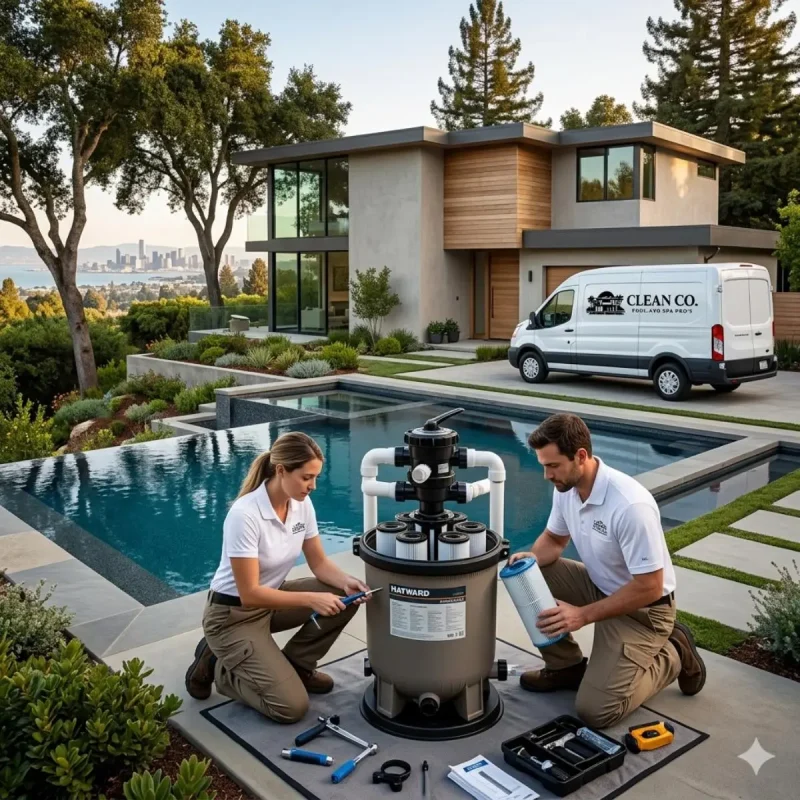
Filter Leaking or Pressure Out of Control? Get a Free Repair Quote
We Are Experts With:




Signs Your Pool Filter Needs Repair
A filter that only needs cleaning drops back to its normal pressure once it’s clean. A filter that needs repair doesn’t. Watch for these:
- Water dripping from the clamp band, lid, drain plug or valve
- Sand or DE showing up on the pool floor
- Pressure far above or below its normal reading
- Pressure that shoots back up soon after a cleaning
- Cloudy water even when the chemistry tests fine
- Air bubbles coming out of the return jets
- A gauge needle that never moves, or sits pinned at the top
One of these alone can be a quick fix. Two or three together usually point to a part inside the filter that has worn out or broken.
Cartridge Filter Problems
Cartridge filters have the fewest moving parts, so most repairs are simple. The cartridge itself is the usual suspect. Pleats tear, end caps crack and the fabric wears thin, especially if someone has been cleaning it with a pressure washer. A torn cartridge lets dirty water slip right past it.
A cartridge that isn’t seated on the center pipe does the same thing. So does a missing or damaged air strainer inside the tank. The water looks cloudy, the pressure looks fine, and the filter isn’t really filtering.
Leaks on a cartridge filter almost always come from the lid, the clamp band or the O-ring between the two halves. A dry, flattened O-ring can also pull air into the filter, which shows up as bubbles at the returns.
DE Filter Problems
If white powder is showing up on the pool floor, the DE filter has a leak inside it. The usual cause is a torn grid. A single small hole in the grid cloth lets DE blow straight through and back into the pool. The same thing happens when the air bleed sock inside the tank is damaged.
A cracked manifold is the other common failure. The manifold holds the grids and carries clean water out of the tank. Once it cracks, dirty water bypasses the grids and the water never really clears.
High pressure on a DE filter that was just backwashed usually means the grid cloth is clogged with oils and minerals, or old DE has piled up in the bottom of the tank. Both need the tank opened and the grids pulled.
Sand Filter Problems
Sand in the pool almost always means a broken lateral. Laterals are the slotted arms at the bottom of the tank that let water out and hold the sand in. When one cracks, sand rides out with the water. High pressure is a common cause, so a filter that has run clogged for months is more likely to break one.
Sand coming out of the backwash line is a different problem. It points to a damaged distributor at the top of the tank, a backwash rate that’s too strong, or sand of the wrong grade for that filter.
If the sand has clumped together or water has cut channels through it, the filter isn’t broken so much as worn out. That’s a job for pool sand changes, not a repair.
Valve, Gauge and O-Ring Problems
Some of the most common filter repairs aren’t inside the tank at all. A multiport valve has a rubber gasket under the handle, often called a spider gasket. When it wears out, water leaks past it and trickles out the backwash line even with the handle on filter.
Push-pull and slide valves have their own O-rings that wear the same way. The pressure gauge is another cheap part that fails often. A gauge that reads zero with the pump running, or never changes, can’t tell you when the filter needs attention.
These parts are inexpensive, but ignoring them costs water, chemicals and eventually a bigger repair.
When High Pressure Isn’t the Filter’s Fault
Pool filter pressure too high right after a cleaning doesn’t always mean the filter is the problem. Anything that restricts water on its way back to the pool raises the reading on the gauge. A partly closed valve on the return side does it. So can a blocked return line or a clogged heater.
Chemical feeders plumbed in the wrong spot cause trouble too. Chlorine should enter the water after the filter and heater, not before them. Fed too early, concentrated chemicals can wear out filter parts and heater components much faster than normal.
That’s why a real filter repair starts with the whole circulation system, not just the tank.
Low Pressure and Weak Flow
Low filter pressure with weak flow at the returns usually starts before the water reaches the filter. A packed pump basket, a full skimmer basket or a partly closed suction valve all starve the pump. An air leak on the suction side does the same thing, and you’ll often see bubbles in the pump lid.
If the baskets are clear and the valves are open, the pump impeller may be clogged or damaged. That’s a pool pump repair, and it’s worth ruling out before any money goes into the filter. A pump that keeps losing prime shows the same symptoms, and running it dry can ruin the shaft seal.
Pool Filter Leaking? Where the Water Is Coming From
Where the water comes out tells you a lot. A drip around the middle of the tank usually means the clamp band or the main O-ring. Water at the top points to the lid, the air relief valve or the valve body. A leak at the bottom can be as simple as a loose drain plug or as serious as a cracked tank.
Unions and fittings on the pipes going in and out of the filter can leak too, and those are easy to mistake for a filter leak. A dry paper towel wrapped around each joint helps pin down the source.
How a Filter Repair Goes
A good filter repair follows the same order every time:
- With the pump on, read the gauge and check it against the filter’s clean reading.
- Check the baskets, valves and return lines, so the filter doesn’t take the blame for a problem somewhere else.
- Shut everything down and release the pressure.
- Open the tank and inspect the cartridges, grids or sand bed, plus the O-rings and internal parts.
- Replace what failed with parts made for that filter.
- Restart, bleed the air out and note the new clean pressure.
That last step matters. The new reading becomes the baseline for every cleaning after it.
Safety Before Anyone Opens the Filter
Pool filters run under real pressure. Before opening one, turn the pump off, open the air relief valve and let the pressure drop to zero. Never loosen a clamp or change a valve position with the pump running.
If the clamp band is corroded, the lid is cracked or the tank shows stress marks, don’t reopen it and put it back in service. Filters in that condition can separate under pressure. Pentair’s filter safety center has model-by-model guidance on inspecting clamps and tanks.
Pool Filter Repair Cost in Milpitas
The price depends on what failed. An O-ring, gasket or gauge is a small repair. A new set of cartridges, a DE grid set or a lateral costs more, and a cracked tank usually means a new filter. Parts for older or discontinued filters can take longer to find, which is another point in favor of replacing. We repair filters from the major brands, including Pentair, Hayward, Jandy and Zodiac, and the quote is free before any work starts.
If replacing beats repairing, our pool equipment installation team can put in a new filter sized for your pump and pool.
Booking Filter Repair in Milpitas
Call (408) 317-7550 or send the form near the top of the page. Tell us what you’re seeing, whether it’s a leak, sand in the pool or a gauge that won’t behave, and which filter type sits on your equipment pad if you know. We’re based in Milpitas and work across the cities listed below. For the rest of our repair work, see the main pool repairs page.
Pool Filter Repair Questions We Hear in Milpitas
Quick answers about broken, leaking and misbehaving filters. Need a hand? Call (408) 317-7550.
It depends on the part that failed. O-rings, gaskets and gauges are small repairs, while grids, laterals or cartridges cost more. We quote for free before any work starts.
Usually a broken lateral at the bottom of a sand filter, which lets sand escape with the water. High pressure is a common cause. The laterals need replacing before the sand goes back in.
A torn grid or a damaged air bleed sock inside the filter. Even a small hole lets DE pass through. Someone has to open the filter and replace the damaged part.
Usually the lid, the air relief valve, the valve body or the O-ring under the clamp band. A worn O-ring is the most common cause and one of the cheapest fixes.
A partly closed return valve, a blocked return line, a clogged sand bed or old DE piled up in the tank. A clogged heater can also raise the reading.
Something is starving the pump: full baskets, a closed suction valve, an air leak on the suction side or a clogged impeller. Check the baskets first.
On a multiport valve, a worn spider gasket lets water leak past and out the waste line even with the handle on filter. Replacing the gasket stops it.
Usually not safely. A tank holds a lot of pressure, and a cracked one can fail. Replacing the filter is the safer and often cheaper choice over time.
Only with the pump off and the air relief valve open so the pressure is at zero. If the clamp is corroded or the tank is cracked, leave it closed and call for help.
No. Weekly visits include an equipment check, and we note any filter problems we spot. We quote repairs separately. Our weekly pool service page lists what each visit covers.