
Pool Light Installation in Milpitas, CA
LED and color-changing pool and spa lights installed safely, with old bulbs swapped out for good.

Schedule Service!
Pool Light Replacement and LED Upgrades
A pool light does more than look nice. It lets you see the steps, the floor and anyone in the water after dark. Our pool light installation in Milpitas swaps tired incandescent and halogen fixtures for LED lights, adds color-changing lights and spa lights, and puts every light back in service with the safety checks it needs.
What Our Light Installation Covers
- LED pool light installation
- Color-changing pool lights
- Spa light installation
- Pool light replacement
Why Most Upgrades Go to LED
LED lights use a fraction of the power of an old incandescent bulb and last many times longer. Once one is in, you rarely have to think about it again.
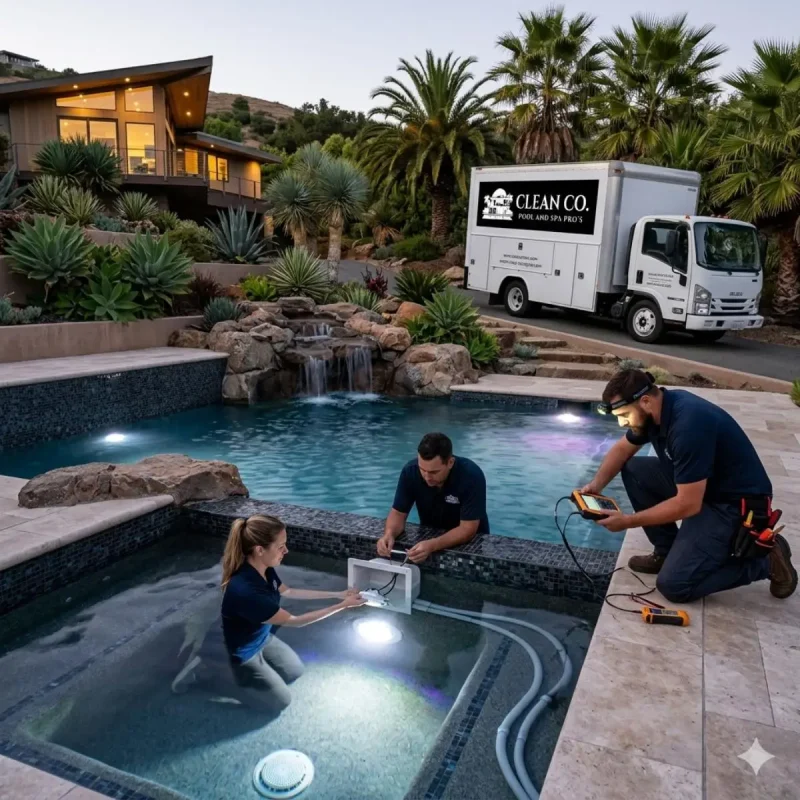
Pool Light Out or Outdated? Get a Free Pool Light Quote
We Are Experts With:




LED Pool Light Replacement
Most pools built before the last decade or so came with incandescent or halogen lights. They run hot and burn out every few years, and they use a lot of electricity for the light they give. An LED replacement fits most existing light niches and changes all three.
Pentair’s LED lighting guide puts it plainly: LED lights use up to 90% less energy than incandescent bulbs and last up to 25 times longer. For a light that runs a few hours most summer evenings, that adds up to real savings and far fewer trips into the pool to change a bulb.
LED lights also come in more options. You can pick a bright white light for swimming at night or a color-changing light with preset shows, and many can be controlled from a remote or the pool’s automation system.
Color-Changing Pool Lights
Color-changing LED lights let you set the mood without adding fixtures. Most cycle through a range of fixed colors and light shows, and you can usually switch between them by flipping the light’s switch in a set pattern or through an automation app.
If you have more than one light, or a pool and a spa, it’s worth making sure the lights can sync so they change together. Lights from the same brand and series usually can. Mixing brands is where syncing tends to break down.
Color lights work well in a spa too. A small spa light matched to the pool lights ties the whole backyard together.
Pool Light Not Working?
When a pool light goes dark, the fixture isn’t always the problem. So check the basics first: the switch, the timer, the breaker and the GFCI that protects the light circuit. A tripped GFCI is a common reason a light stops working, and it can mean water has found its way into the fixture.
If power is reaching the light and it still won’t turn on, the bulb or LED module has usually failed. On an older incandescent light, that’s often the moment to switch to LED instead of buying another bulb. Water inside the lens, a cracked lens or a corroded fixture means the whole light needs replacing.
Never swim with a light that’s flickering, tripping the GFCI or has water inside it. Leave the circuit off until someone has checked it.
Why Pool Light Safety Matters
An underwater light puts electricity and water within inches of each other. The electrical code requires GFCI protection on pool light circuits that run above 15 volts, and every light also needs a bond wire tying it to the pool’s other metal parts.
Older pools don’t always meet today’s code. Pools built more than about 30 years ago may not have GFCI protection on their light circuits at all. If yours is one of them, replacing the light is a good time to fix that too.
Power should always be off at the breaker before anyone touches a pool light, even to change a bulb.
Low-Voltage and Line-Voltage Pool Lights
Pool lights come in two main types. Line-voltage lights run on 120 volts straight from the house circuit. Low-voltage lights run on 12 volts and need a transformer to step the power down.
Low-voltage lights are popular because they add a layer of safety, and many LED replacements come in both versions. The key is matching the new light to what the pool is wired for. A 12-volt light connected to a 120-volt circuit will fail right away, and the reverse won’t light at all. If you want to switch from line voltage to low voltage, a transformer has to be added.
The Light Niche and Cord
Most in-ground pool lights sit in a light niche, a metal or plastic housing built into the pool wall. The light is designed to be pulled up out of the niche, on its long cord, and serviced on the deck. That’s why a proper replacement light comes with enough cord to reach the deck.
Changing a light usually doesn’t require draining the pool. The fixture comes up to the surface, gets swapped or rewired at the deck, then goes back into the niche. If the niche itself is damaged or the wrong size, the job gets bigger, but that’s uncommon.
Spa Lights
Spa lights are smaller versions of pool lights, built for the smaller niche in a spa wall. The same choices apply: LED or older bulb, white or color, low voltage or line voltage.
A spa light on its own switch or synced with the pool lights makes the spa easier and safer to use at night. Steps and seats are much easier to see in lit water. For a tub with no heat or weak jets, see spa repair for heater, pump and jet fixes.
How Much Power a Pool Light Uses
Older incandescent pool lights often draw 300 to 500 watts, about as much as several household appliances running at once. Because an LED makes light far more efficiently, many replacements draw a small fraction of that for the same or brighter light.
Since pool lights tend to run for hours on summer nights, the difference shows up on the power bill. It also means less heat inside the fixture, which is easier on the lens gasket and the cord.
Signs It’s Time to Replace a Pool Light
- Water or fog inside the lens
- A lens that’s cracked, cloudy or yellowed
- Rust or corrosion on the fixture ring
- A light that flickers or trips the GFCI
- An incandescent light that burns through bulbs every season
Any one of these is a good reason to replace the whole fixture with an LED rather than patching the old one.
Pool Light Replacement Cost
The price depends on the light you choose, how many lights you have, if you’re switching voltage, and how easy the existing wiring is to work with. Replacing one light in a standard niche with an LED of the same voltage is the simplest job. Adding a transformer, adding GFCI protection or syncing several color lights takes more work.
LED lights cost more than a replacement incandescent bulb up front, but they use far less power and rarely need replacing. The free quote shows each option and its price, so you can compare.
Planning a Lighting Upgrade
A little planning up front makes a lighting upgrade look better. Count the lights in the pool and spa, and note whether they’re all on one switch. Decide if you want white light for night swimming, color for evenings with guests, or both.
Then think about control. A single color light is easy to run from its wall switch. Several lights that should change together, or lights you want on a schedule, work better through an automation system. Planning both at once saves wiring work later.
How a Pool Light Installation Goes
- Turn off the power to the light circuit at the breaker.
- Remove the old light from its niche and bring it up to the deck.
- Check the niche, cord, junction box and bonding.
- Connect the new LED light and seat it back in the niche.
- Confirm GFCI protection on the circuit.
- Restore power and test the light, colors and any sync or automation control.
Getting More From Your Pool Lights
- Put the lights on a timer or your automation system so they’re only on when you’re out there.
- Choose one brand and series if you want several color lights to change together.
- Test the GFCI every few months with its test button.
- Call for help if a light fogs up inside, flickers or trips the breaker.
For automated lighting schedules and phone control, see our pool automation page.
Booking Pool Light Installation in Milpitas
To book, call (408) 317-7550 or send the request form. Mention how many lights the pool has, if there’s a spa light, and if you’d like white or color-changing LEDs. Light jobs run throughout Milpitas and the rest of our service area. Other equipment installs are listed on the pool equipment installation page.
Pool Light Installation Questions
What people ask before upgrading or replacing pool lights. Questions of your own? Call (408) 317-7550.
It depends on the light, the number of lights and the wiring. A same-voltage LED swap in an existing niche is simplest. Quotes are free.
Usually yes. LED lights use up to 90% less energy than incandescent bulbs and last many times longer, and they come in white or color-changing versions.
No. Pool lights are built to be pulled up out of their niche on a long cord and serviced on the deck, then put back in the water.
Check the switch, timer, breaker and GFCI first. If power is getting to the light, the bulb or LED has likely failed, or water has gotten inside the fixture.
Usually water inside the fixture or damaged wiring. Leave it off, since that's exactly the kind of fault a GFCI is there to catch, and have the light checked.
12-volt lights run through a transformer that steps the power down, and 120-volt lights run on house current. The new light has to match the pool's wiring.
In most cases, yes. Many LED replacements are made to fit standard niches. We check the niche size, cord and wiring before choosing the light.
Yes, if they're compatible. Lights from the same brand and series usually sync. Mixing brands is where syncing tends to fail.
Much longer than incandescent bulbs, often up to 25 times as long. Many owners go years without touching them.
Only with the breaker off, and only if the wiring and GFCI are in good shape. Because it mixes water and electricity, many owners leave it to a pro.