
Pool Salt Systems in Milpitas, CA
Salt water conversions, salt cell cleaning and replacement, and water kept in the range your cell needs.

Schedule Service!
Salt Water Pool Conversions and Salt Cell Service
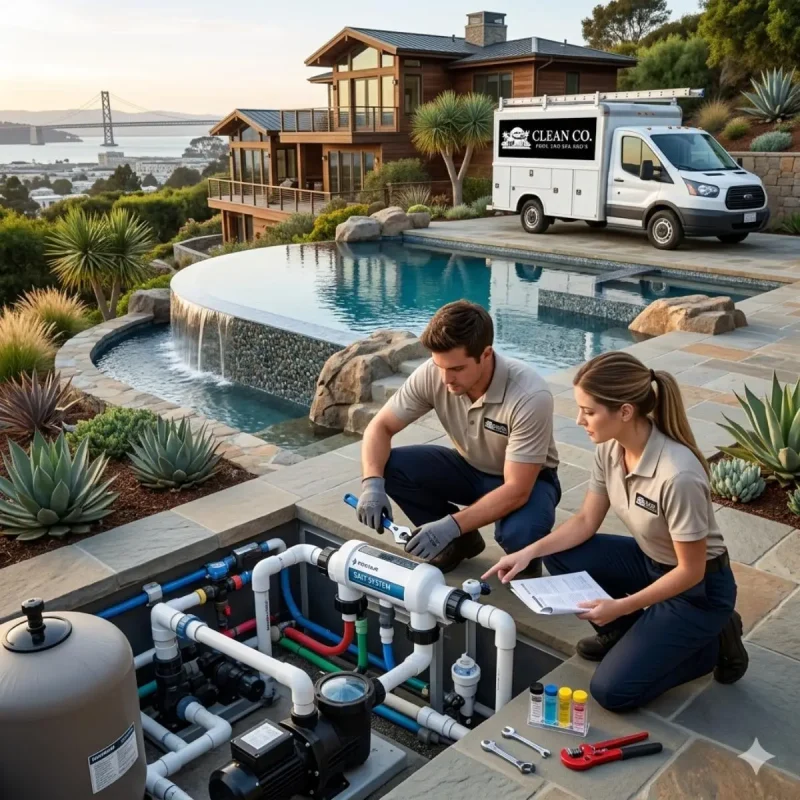
A salt system makes chlorine right in your plumbing, so you stop buying jugs and tablets. Our pool salt system service in Milpitas covers converting a chlorine pool to salt, keeping the salt cell clean and working, and replacing it when it wears out.
What Our Salt System Service Covers
- Salt water pool conversions
- Salt chlorine generator installation
- Salt cell cleaning and inspection
- Salt cell replacement
- Salt level and water balance testing
Still a Chlorine Pool
Salt doesn’t replace chlorine. It’s the raw material the cell turns into chlorine, so you still test and balance the water like you would in any other pool.
Thinking About Salt, or Is Your Cell Acting Up? Get a Free Quote
We Are Experts With:




How a Salt Water Pool System Works
A salt water pool system has two main parts: a cell plumbed into the return line and a power supply that runs it. The cell holds a stack of metal plates. When salty water flows between them and the plates are powered, electrolysis turns some of the salt into chlorine.
That chlorine does its job in the pool, then breaks back down into salt. So the same salt gets used over and over, and the system is close to self-sustaining. You only add salt to make up for water that leaves the pool through backwashing, splash-out, rain overflow or swimmers carrying it out.
Most systems run with about 3,000 to 3,500 ppm of salt. That’s far less salty than the ocean, and most people can barely taste it. Your cell’s manual gives the exact range it wants.
Salt Water Pool Conversion
Converting a chlorine pool to salt doesn’t mean draining it. The cell goes into the plumbing, the power supply mounts near the pad, and salt goes straight into the pool water. It belongs after the filter and heater, since concentrated chlorine flowing through a heater corrodes it.
The salt dose is bigger than most people expect. Getting to 3,000 ppm takes about 250 pounds of salt for every 10,000 gallons. For a pool holding 20,000 gallons, that’s roughly 500 pounds to start, less if there’s already some salt in the water from years of chlorine use.
Every system also has a safety interlock that shuts the cell off when the pump isn’t running. The cell makes a trace of hydrogen gas, and moving water carries it away.
Salt Chlorine Generator Sizing
Salt chlorine generators are rated by how many gallons of pool they can handle. It’s smart to pick one rated a size above your pool. A cell that doesn’t have to run at full output all summer lasts longer and has room to catch up after a hot week or a big party.
How long it runs matters too. The cell only makes chlorine while water flows through it, so a short pump schedule limits how much chlorine it can make. Pairing salt with a variable speed pump that runs longer at low speed works well.
What Salt Does to Your Water Chemistry
A salt pool behaves a little differently from a pool fed with tablets. The pH tends to creep up over time, so it needs acid more often. Many salt pool owners add a little every week or two.
Stabilizer still matters outdoors, since the sun burns off unprotected chlorine fast. Calcium and pH matter even more than usual, because scale forms on the cell’s plates when the water leans toward scaling. Keeping the water balanced is the best thing you can do for the cell.
How to Clean a Salt Cell
Most cells clean themselves by switching the direction of the current on a regular cycle, which knocks loose scale on the plates. That slows buildup but doesn’t always stop it, especially in hard water.
- Switch off the salt system and the pump at the breaker.
- Remove the cell and look between the plates for white, crusty scale.
- If there’s buildup, soak the cell in a diluted acid solution as the manual directs.
- Rinse it well and put it back in.
Never scrape the plates with anything metal, since the coating on them is what makes chlorine. Clean only when there’s scale to remove, because every acid bath wears the coating a little.
Salt Cell Replacement
Salt cells wear out. The plates carry a thin coating that makes the chlorine, and it slowly wears away with use. Cells are rated for a certain number of operating hours, so a cell that runs long days at high output reaches the end sooner.
Signs a cell is near the end:
- Chlorine stays low even with the cell clean and output turned up
- A check cell or low output warning that won’t clear
- Plates that look worn, patchy or bare
- The cell needs cleaning far more often than it used to
Before replacing a cell, it’s worth ruling out low salt, a bad flow switch or a power supply problem, since those cause the same symptoms.
Salt Level Too Low or Too High
Low salt is the most common salt system problem. The cell makes less chlorine and wears faster trying to keep up. Most systems measure the salt and show a warning when it drops out of range.
Too much salt is usually a smaller issue, but some cells stop working or flash a warning when it’s well over the top of the range. The only fix is replacing some of the water with fresh. When you add salt, use pool salt that’s nearly pure sodium chloride. Jandy’s AquaPure page calls for salt at least 99.8% pure, non-iodized and food quality.
Can You Shock a Salt Water Pool?
Yes. Most systems have a boost or super-chlorinate mode that runs the cell at full output for a set time. That works for a routine boost after a party or a heat wave.
For a bigger job, like algae or cloudy water, adding liquid chlorine is faster. It won’t hurt the cell, and it’s the same chlorine the cell makes, just all at once.
Caring for a Salt Water Pool
A salt system takes the chlorine chore off your list, not the rest of pool care. The water still needs weekly testing for chlorine and pH, plus regular checks of salt, alkalinity, calcium and stabilizer. Baskets, the filter and brushing all stay the same.
Our weekly pool service covers salt pools, including the salt level and cell checks.
Salt, Stone and Equipment
Salt water can be hard on some materials around the pool. Natural stone coping and decking can wear faster when salty water splashes and dries on them, so sealing the stone helps. Some metal parts, like ladders and light rings, also do better with a fresh water rinse now and then.
Before a conversion, it’s worth checking that your heater and other equipment are rated for salt water. Heater manuals usually list a salt limit, and older models can be stricter.
Salt Systems and Pool Automation
A salt cell doesn’t need its own box on the wall if your pool has automation. Plenty of controllers power the cell themselves, and then output, cell status and salt warnings show up on your phone next to everything else. If you’re planning automation anyway, adding salt at the same time saves a second round of wiring. See pool automation for what’s possible.
Salt Pools and Milpitas Water
Calcium in the fill water is what ends up as scale on the cell plates. Milpitas gets water from more than one source, and hardness can vary from one neighborhood to the next. So the first test before a conversion is calcium, and it gets checked again regularly after.
If your water runs hard, plan on looking at the cell more often. A scale inhibitor can help, and so can keeping pH from drifting high, since high pH and high calcium together are what drive scale. Heavy scale on the pool tile is its own job, covered on our pool tile cleaning page.
Salt System Cost
A salt conversion costs more up front than a bucket of tablets. What you pay comes down to pool volume, the cell and power supply you choose, and if it runs on its own or through an automation system. The salt to fill the pool adds to the first-year cost.
After that, you stop buying chlorine, but the cell becomes a part that eventually needs replacing. Replacement cells vary widely by brand and size. The free quote spells out both the conversion and the cell costs.
Booking Salt System Service in Milpitas
Ring us at (408) 317-7550 or book through the form, and tell us your pool’s size and the make of any salt system you have now. Salt conversions and cell service are available across Milpitas and nearby cities on our map. For a cell that’s still under suspicion after cleaning, our pool repairs page covers salt system repair.
Pool Salt System Questions
Quick answers about salt water pools, cells and conversions. Anything we missed? Call (408) 317-7550.
It depends on pool size, the cell model and if it runs through automation. The salt to fill the pool adds to it. Quotes are free.
A cell in the plumbing turns dissolved salt into chlorine. The chlorine breaks back down into salt, so the same salt keeps getting reused.
Most systems want about 3,000 to 3,500 ppm. Reaching 3,000 ppm takes roughly 250 pounds of salt for every 10,000 gallons.
Several years, depending on hours of use, output setting and water balance. Hard water and high output shorten its life.
Low chlorine with a clean cell and correct salt, a warning that won't clear, or worn-looking plates. Rule out low salt and flow problems first.
Only when scale builds up. Check it every few months. Every acid cleaning wears the plate coating a little, so don't clean it on a fixed schedule.
Yes. Use the system's boost mode for small jobs, or add liquid chlorine for algae or cloudy water. It won't harm the cell.
Salt pools tend to push pH up over time. Adding acid regularly, often every week or two, keeps it in range.
Yes, if it's outdoors. Without stabilizer, sunlight burns off the chlorine the cell makes before it can do its job.
Pool salt that's nearly pure sodium chloride, non-iodized and without anti-caking additives. Table salt and rock salt can cause stains.