
Pool Filter Cleaning in Milpitas, CA
Cartridge, DE and sand filters cleaned back to their starting pressure, so the water moves and stays clear.

Schedule Service!
Pool Filter Cleaning Service for Cartridge, DE and Sand Filters
A clogged filter is the most common reason a pool with good chemistry still looks dull. Our pool filter cleaning service in Milpitas gets the dirt and oils out of the filter and brings the pressure back down to where it started. Water moves again, the pump stops straining, and the chlorine can do its job.
What Our Filter Cleaning Includes
Every cleaning covers:
- Cartridge filter cleaning
- DE filter cleaning and a fresh DE charge
- Sand filter backwash and rinse
- Built-up debris removed from the tank and baskets
- Filter pressure checked before and after
- A look at the rest of the circulation system
Two Cleanings a Year With Weekly Service
If you’re on our weekly pool service, two filter cleanings a year come with the monthly price. We also read the gauge on every visit. If the filter clogs early, you hear about it in the visit report instead of finding out from cloudy water.
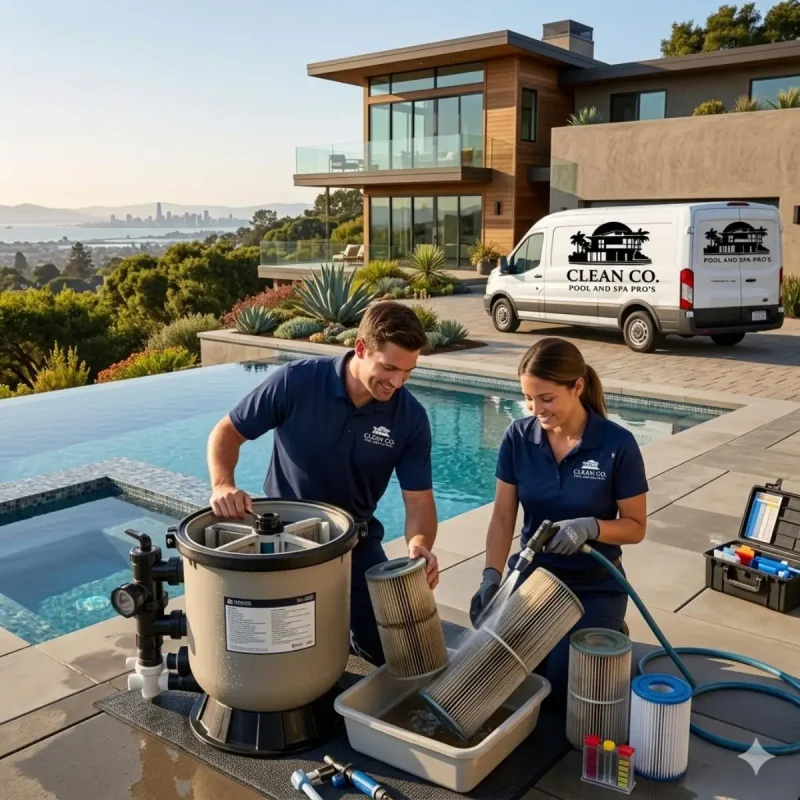
Filter Gauge Climbing? Call Clean Co Pools for a Free Quote
We Are Experts With:




How Often to Clean a Pool Filter
Clean it when the pressure gauge says so, not when the calendar does. Every filter has a clean starting pressure, which is the reading right after a good cleaning. Once the gauge sits 8 to 10 psi above that number, the filter has loaded up and needs a cleaning.
For most home pools, that works out to a full cleaning about twice a year, with sand and DE filters backwashed in between as the pressure calls for it. Some pools need more. A pool under trees, a pool full of swimmers all summer, or one that just came back from green can load a filter in a few weeks.
Around Milpitas, the busy stretch runs from late spring through September. Hot afternoons mean longer pump run times and more swimmers, and sunscreen rinses off every one of them into the water. In fall, leaves that slip past the skimmer break down into fine muck that goes straight to the filter.
Here’s a simple trick. After a cleaning, write the clean pressure on a strip of tape on the filter tank. The gauge then becomes a yes-or-no check that anyone in the house can read.
Cartridge Filter Cleaning
A cartridge filter traps dirt in pleated polyester fabric and catches particles down to about 10 to 25 microns. You can’t backwash it, so the only way to clean it is to take the cartridges out. A proper cartridge filter cleaning goes like this:
- Turn the pump off at the breaker and open the air relief valve on top of the filter to bleed off the pressure.
- Open the tank and pull the cartridges.
- Hose each pleat from top to bottom with a garden hose.
- Soak the cartridges in a filter degreaser if oils have built up. Sunscreen and body oils coat the pleats, and water alone won’t lift them.
- Use an acid cleaner for scale only after the degreaser. Acid first can set the oils into the fabric for good.
- Check the pleats for tears and the O-ring for wear, lube the O-ring, then close the tank and restart.
Don’t skip the first step. A pressure filter holds a lot of force, and trapped air can push the lid off the tank. That’s why Pentair’s filter safety guide tells owners to cut the power and release the air before opening one.
DE Filter Cleaning
A DE filter catches the finest dirt of any pool filter, down to about 2 to 6 microns. It works by coating fabric-covered grids with diatomaceous earth, a white powder made from fossilized diatoms. The DE does the filtering, and the grids just hold it in place.
When the pressure climbs 8 to 10 psi, a backwash flushes out the used DE and dirt, and a fresh charge goes back in through the skimmer. That buys time, but it isn’t a full cleaning. Oils and minerals slowly work into the grid cloth, and the DE starts sticking to it. So the grids still need a teardown now and then. That means pulling the grids, spraying them down and soaking them in degreaser, then using an acid cleaner on any calcium. Last, check the cloth for tears. A torn grid lets DE blow straight into the pool, and you’ll see it as a fine white dust on the floor.
The amount of DE matters too. The usual dose is about 1.25 pounds for every 10 square feet of filter area, and the label on the tank lists the size. Too little leaves the cloth bare, so oils clog it. Too much packs the gaps between the grids and chokes the flow. DE dust isn’t safe to breathe either, so wear a mask when you pour it.
Sand Filter Cleaning and Backwashing
Sand filters clean themselves, up to a point. A backwash reverses the flow, lifts the sand bed and flushes the trapped dirt out to waste. You run it until the water in the sight glass turns clear, then run a short rinse to settle the sand before going back to filter.
How often to backwash comes back to the gauge: 8 to 10 psi over the clean reading. Backwashing every week sounds careful, but it works against you. A sand filter gets better as it loads up, because dirt narrows the gaps between the grains and catches finer particles. Backwash too early and the filter never gets there, so the water stays a little dull.
A backwash can’t fix everything, though. Oils and minerals can glue the sand into clumps, and then water cuts channels through the bed and skips the filtering altogether. If the pressure stays low but the water stays cloudy, the sand may be done. That calls for pool sand changes, not another backwash.
Signs Your Pool Filter Needs Cleaning
The gauge is the best sign, but it isn’t the only one. Watch for:
- Pressure 8 to 10 psi above the clean reading
- Weak flow from the return jets
- Cloudy water even when chlorine and pH test fine
- A skimmer that barely pulls debris in
- Pressure that climbs back up within days of a cleaning
That last one usually means the cleaning didn’t get the oils out, or algae is loading the filter as fast as it gets cleaned. High pressure can also come from a partly closed valve or a blocked return line. That’s why we check the rest of the circulation before blaming the filter. And if air bubbles spit out of the return jets right after a cleaning, the lid or O-ring usually isn’t sealing.
Why a Clean Filter Matters for Your Water and Equipment
The filter is the only thing in the system that pulls fine dirt out of the water. Pools are generally set up to run all their water through the filter about every six hours. A clogged filter slows that down, so dirt stays in the water longer and keeps using up chlorine.
The pump pays for it too. It pushes against more resistance and moves less water for the same run time. Heaters need steady flow as well, and many will shut themselves off when flow drops too low.
Then there’s algae. Spores ride around in the water all the time, and a filter that can’t catch them gives algae a head start. A clean filter won’t replace chlorine, but it makes the chlorine’s job a lot easier. A dirty filter also hides the real problem. When the water turns cloudy, most people reach for more chlorine, when the fix is a clean filter.
Cleaning, Repair or Replacement?
A hose can’t solve every filter problem. A cleaning handles dirt, oils and scale. It can’t fix a torn cartridge, a cracked DE grid, a broken part inside a sand tank or a valve that leaks. Those go to our pool filter repair team.
Cartridges also wear out. Most last one to three years in a home pool, and pleats that feel soft or flattened won’t hold dirt no matter how clean they are. When the tank itself is cracked, a new filter makes more sense than another fix. Our pool equipment installation page covers replacements.
What You Can Do Between Filter Cleanings
A few habits stretch the time between cleanings:
- Check the gauge once a week with the pump running and compare it to the clean number.
- Clear the skimmer basket after wind or leaf drop, before the debris breaks down and packs into the filter.
- If you have a cartridge filter, keep a spare set. You swap it in and clean the dirty set without leaving the pool unfiltered.
- Go easy on clarifiers and filter aids. They help in the short term, but over time they can pack a sand bed into a solid mass.
- Never open a pressure filter with the pump running or air still inside.
Booking Pool Filter Cleaning in Milpitas
Two filter cleanings a year come with our weekly service, and that plan runs from $205 a month, chemicals included. For a free quote, fill out the form at the top of this page or phone (408) 317-7550. Our home base is Milpitas, CA, and we also clean filters in Fremont, Newark, San Jose, Sunnyvale and the other cities listed below. It helps to know what kind of filter you have, and the label on the tank usually says cartridge, DE or sand. For the rest of what we clean, see our pool cleaning page.
Pool Filter Cleaning Questions From Milpitas Pool Owners
Short answers to what people ask us about pool filters. Don’t see yours? Give us a call: (408) 317-7550.
Two filter cleanings a year come with our weekly service, which runs from $205 a month, chemicals included. For your pool's exact price, get a free quote at (408) 317-7550.
Once the gauge reads 8 to 10 psi over its reading when clean. For most home pools that means a full cleaning about twice a year, and more often under trees or after algae.
It depends on the filter, pump and plumbing, so there's no single right number. Note the reading right after a cleaning. When it climbs 8 to 10 psi above that, clean the filter.
Backwash a sand or DE filter when the pressure is 8 to 10 psi higher than it read when clean, not on a fixed schedule. Backwashing too often keeps a sand filter from catching the finest dirt.
No. You can't backwash a cartridge filter. The cartridges come out of the tank and get hosed off, with a degreaser soak when oils build up. A spare set cuts the downtime.
No. A pressure washer can shred the pleats and drive dirt deeper into the fabric. A garden hose with a spray nozzle, worked from the top of each pleat down, does the job safely.
Usually one to three years in a home pool. Replace it sooner if the pleats are torn, flattened or soft, or if the pressure climbs right back up after a good cleaning.
A cartridge that isn't seated right, a torn cartridge or DE grid, or too much flow can let dirty water slip past. New sand can also release fine dust for a few backwashes.
Usually oils were left in the media, algae is loading the filter, or the pump pushes more flow than the filter is rated for. A partly closed return valve can do it too.
Cleaning removes dirt, oils and scale. A crack, a torn element, a leak or a stuck valve needs a repair instead. Our pool filter repair page covers those.